
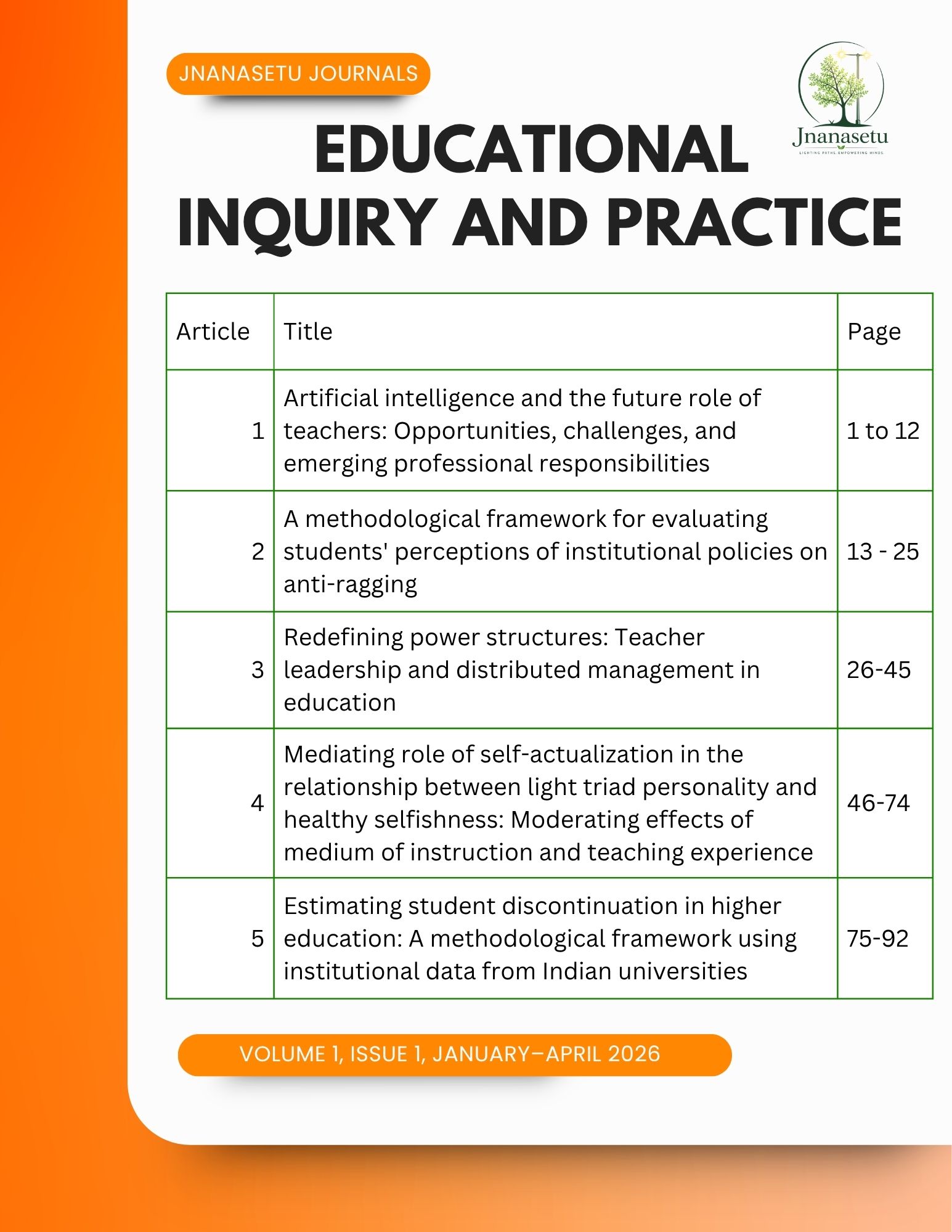
Estimating student discontinuation in higher education: A methodological framework using institutional data from Indian universities
DOI:
https://doi.org/10.66483/eip.2026.1.1.005Keywords:
Academic Discontinuation, Higher education, Methodological framework, NIRFAbstract
Student discontinuation remains a significant concern in higher education research and policy, particularly in contexts characterised by expanding enrolment and institutional diversification. However, existing studies often rely on inconsistent definitions and fragmented measurement approaches, limiting comparability across institutions. Although institutional datasets such as the National Institutional Ranking Framework provide standardised information on admissions and graduation outcomes, their potential for discontinuation analysis remains underutilised. In addition, institutional datasets often cannot distinguish between permanent dropout and institutional discontinuation, leading to conceptual and methodological ambiguity. The study proposes a methodological framework for estimating student discontinuation using institutional-level indicators. The framework introduces a standardised estimation model based on admitted student counts and graduation outcomes and outlines a replicable analytical workflow for institutional analysis. The applicability of the framework was illustrated using NIRF data from three selected central universities in India. The study contributes by clarifying the conceptual distinction between dropout and discontinuation, introducing a replicable estimation framework, and demonstrating how institutional ranking datasets may be repurposed for progression-oriented higher education research. The framework may support comparative institutional analysis, methodological standardisation, and exploratory policy assessment in contexts where longitudinal student-level tracking systems remain limited.
References
Bean, J. P. (1980). Dropouts and turnover: The synthesis and test of a causal model of student attrition. Research in Higher Education, 12(2), 155–187. https://doi.org/10.1007/BF00976194
Bean, J. P. (1980). Dropouts and turnover: The synthesis and test of a causal model of student attrition. Research in Higher Education, 12(2), 155–187. https://doi.org/10.1007/BF00976194
Braxton, J. M. (Ed.). (2000). Reworking the student departure puzzle. Vanderbilt University Press.
Cabrera, A. F., Nora, A., & Castañeda, M. B. (1993). College persistence: Structural equations modeling test of an integrated model of student retention. The Journal of Higher Education, 64(2), 123–139. https://doi.org/10.1080/00221546.1993.11778419
Hagedorn, L. S. (2005). How to define retention: A new look at an old problem. In A. Seidman (Ed.), College student retention: Formula for student success (pp. 89–105). Praeger.
Maxwell, J. A. (2012). A realist approach for qualitative research. Sage.
Ministry of Education. (2025). India rankings 2025: National Institutional Ranking Framework (NIRF). Government of India. (NIRF India)
NIRF Methodology Documents
NIRF Official Website
Pascarella, E. T., & Terenzini, P. T. (2005). How college affects students: A third decade of research (Vol. 2). Jossey-Bass.
Spady, W. G. (1970). Dropouts from higher education: An interdisciplinary review and synthesis. Interchange, 1(1), 64–85. https://doi.org/10.1007/BF02214313
Tinto, V. (1975). Dropout from higher education: A theoretical synthesis of recent research. Review of Educational Research, 45(1), 89–125. https://doi.org/10.3102/00346543045001089
Tinto, V. (1993). Leaving college: Rethinking the causes and cures of student attrition (2nd ed.). University of Chicago Press.
Yorke, M. (1999). Leaving early: Undergraduate non-completion in higher education. Falmer Press.
Downloads
Published
Versions
- 2026-08-11 (2)
- 2026-06-15 (1)
Data Availability Statement
No primary data is used in the study
Issue
Section
License
Copyright (c) 2026 B Radha Krishna Murthy, Akhileshwar Pandey, Prof. Mamillapally Vijay Kumar Sharma (Author)

This work is licensed under a Creative Commons Attribution-NonCommercial 4.0 International License.