
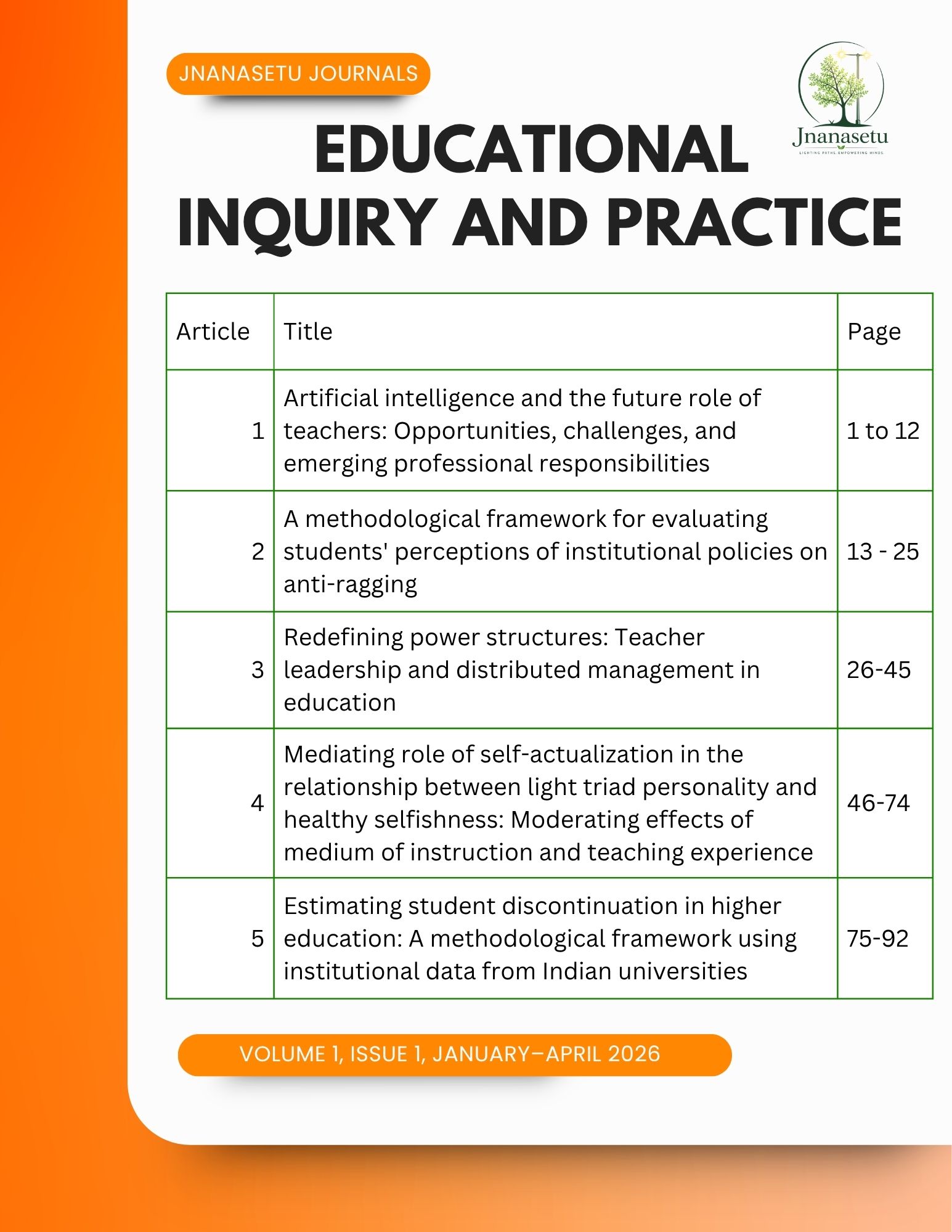
Redefining power structures: Teacher leadership and distributed management in education
DOI:
https://doi.org/10.66483/eip.2026.1.1.003Keywords:
TEACHER LEADERSHIP, DISTRIBUTED LEADERSHIP, DISTRIBUTED MANAGEMENT PRINCIPLES,, RELATIONAL POWER, ORGANISATIONAL ADAPTABILITY, HIERARCHICAL FLATTENINGAbstract
The hierarchical nature of different institutional arrangements, especially those that are entrenched in the Indian context, has, historically and to some extent, suppressed the agency of teachers, hampered innovation, and reduced their responsiveness to the changing needs of modern education. The centralisation of authorities, which is based on these top-down structures with roots in colonial bureaucratic legacies, limits the power to make professional decisions and empower teachers. It presents a perspective on the future of teacher leadership, as conceptualised by the authors as an informal, expertise-based influence that is not confined to the classroom setting, but redefines leadership as a distributed, place-based praxis. This reconceptualization aims at reducing rigorous hierarchies through the prism of distributed management principles. Based on the development of distributed leadership as an emergent phenomenon by Spillane and others, which is built upon the interactions between actors, contexts, and artefacts, the paper will incorporate teacher-leadership conceptions that forecast empowerment, the development of professional communities, and influence within the school system. Theoretical underpinnings based on organisational learning, social constructivism, analysis of managerialism, and ideas of relational power support the suggestion that the hierarchies can be redesigned into horizontal, networked interdependencies. The Consistent model proposed is the Distributed Teacher Leadership Model (DTLM) that aligns the mobilisation of instructional leaders into distributed systems and the decentralisation of hierarchical structures and processes of interdependence and redistribution of authority and development of adaptability, agency, and collective efficacy. In addition, the DTLM aligns with the focus on teacher empowerment and decentralised governance outlined in the National Education Policy (NEP 2020), which provides conceptual connections between bureaucratic structures in their inner core based on equitable and democratic processes. The model achieves international pertinence with its appeal to the larger paradigm shift that is post-heroic, relational leadership in the complex educational contexts. The authors observe that distributed teacher leadership is potentially transformative to the development of responsive and inclusive organisations, but conclude by accepting that additional theoretical development, especially relating to critical social-justice and post-colonial aspects, is still achievable.
References
1. Argyris, C., & Schön, D. A. (1978). Organizational learning: A theory of action perspective. Addison-Wesley.
2. Ball, S. J. (2013). Foucault, power, and education. Routledge. https://doi.org/10.4324/9780203078662
3. Bhola, S., & Dhanawade, S. (2024). Antecedents and consequences of distributed leadership in Indian higher education. International Journal of Educational Management. https://doi.org/10.1108/IJEM-03-2023-0116
4. Cheng, A. Y., & Szeto, E. (2016). Teacher leadership development and principal facilitation: Novice teachers’ perspectives. Teaching and Teacher Education, 58, 140–148. https://doi.org/10.1016/j.tate.2016.05.003
5. Cheung, R., Reinhardt, T., Stone, E., & Little, J. W. (2018). Defining teacher leadership: A framework. Phi Delta Kappan, 100(3), 38–44. https://doi.org/10.1177/0031721718809069
6. Crawford, M. (2012). Solo and distributed leadership: Definitions and dilemmas. Educational Management Administration & Leadership, 40(5), 610–620. https://doi.org/10.1177/1741143212451175
7. Conan Simpson, J. (2021). Fostering teacher leadership in K-12 schools: A review of the literature. Performance Improvement Quarterly, 34(2), 229–246. https://doi.org/10.1002/piq.21374
8. Deem, R. (2003). Death to critique and dissent? The policies and practices of new managerialism and of ‘evidence-based practice’. Gender and Education, 15(1), 65–84. https://doi.org/10.1080/0954025032000042167
9. Eckert, J., & Daughtrey, A. (2019). Teacher leadership development: Tracking one district’s progress over three years. Education Policy Analysis Archives, 27, Article 42. https://doi.org/10.14507/epaa.27.4130
10. Foucault, M. (1980). Power/knowledge: Selected interviews and other writings, 1972–1977. Pantheon Books.
11. Frontiers in Education. (2025). Understanding teacher agency in implementing inclusive education policy. Frontiers in Education. https://doi.org/10.3389/feduc.2025.1678998
12. Government of India. (2020). National Education Policy 2020. Ministry of Education. https://www.education.gov.in/sites/upload_files/mhrd/files/NEP_Final_English_0.pdf
13. Gronn, P. (2002). Distributed leadership as a unit of analysis. The Leadership Quarterly, 13(4), 423–451. https://doi.org/10.1016/S1048-9843(02)00120-0
14. Gronn, P. (2009). Leadership configurations. Leadership, 5(3), 381–394. https://doi.org/10.1177/1742715009337770
15. Hallinger, P. (2005). Instructional leadership and the school principal: A passing fancy that refuses to fade away. Leadership and Policy in Schools, 4(3), 221–239. https://doi.org/10.1080/15700760500244793
16. Harris, A. (2008). Distributed leadership: According to the evidence. Journal of Educational Administration, 46(2), 172–188. https://doi.org/10.1108/09578230810863253
17. Harris, A. (2014). Distributed leadership matters: Perspectives, practicalities, and potential. Corwin Press. https://doi.org/10.4135/9781483332574
18. Indian Express. (2020, August 14). A system of hierarchy. https://indianexpress.com/article/opinion/columns/nep-education-system-caste-hierarchy-inequality-6789387
19. Khalifa, M. A., Khalil, D., Marsh, T. E. J., & Halloran, C. (2019). Toward an Indigenous, decolonizing school leadership: A literature review. Educational Administration Quarterly, 55(4), 571–614. https://doi.org/10.1177/0013161X18809348
20. Kumar, S., & Choudhury, P. (2024). Skills and role of teacher according to NEP 2020. Zenodo. https://doi.org/10.5281/zenodo.14723440
21. Leithwood, K., & Jantzi, D. (2005). A review of transformational school leadership research 1996–2005. Leadership and Policy in Schools, 4(3), 177–199. https://doi.org/10.1080/15700760500244769
22. Limin Zhang, Tingting Wu, Lijia Liu, Ping Ren, & Chaopai Lin. (2022). The relationship between Chinese preschool principal leadership styles and teacher leadership: Exploring the mediating effect of psychological capital. Frontiers in Psychology, 13, Article 1006184. https://doi.org/10.3389/fpsyg.2022.1006184
23. Muijs, D., & Harris, A. (2006). Teacher led school improvement: Teacher leadership in the UK. Teaching and Teacher Education, 22(8), 961–972. https://doi.org/10.1016/j.tate.2006.04.010
24. Mifsud, D. (2021). Distributed leadership: A critical analysis. Journal of Educational Administration, 59(3), 303–317. https://doi.org/10.1108/JEA-06-2020-0239
25. Nicholas Sun-keung Pang, & Zhuang Miao. (2017). The roles of teacher leadership in Shanghai education success. In BCES Conference Books (Vol. 15, pp. 93–100). https://doaj.org/article/d61f2882821c4f91ab7149e6bbfefea2
26. Rolf Blank. (2021). New research on teacher leadership in schools: Efficacy of a survey method for analyzing multiple dimensions of leadership. Journal of Interdisciplinary Teacher Leadership. https://doi.org/10.46767/kfp.2016-0036
27. Senge, P. M. (1990). The fifth discipline: The art and practice of the learning organization. Doubleday/Currency.
28. Spillane, J. P. (2006). Distributed leadership. Jossey-Bass.
29. Spillane, J. P., Halverson, R., & Diamond, J. B. (2004). Towards a theory of leadership practice: A distributed perspective. Journal of Curriculum Studies, 36(1), 3–34. https://doi.org/10.1080/0022027032000106726
30. Tarek Shal, Norma Ghamrawi, Abdullah Abu-Tineh, Yousef M. Al-Shaboul, & Abdellatif Sellami. (2024). Teacher leadership and virtual communities: Unpacking teacher agency and distributed leadership. Education and Information Technologies. https://doi.org/10.1007/s10639-023-12446-5
31. Theoharis, G. (2007). Social justice educational leaders and resistance: Toward a theory of social justice leadership. Educational Administration Quarterly, 43(2), 221–258. https://doi.org/10.1177/0013161X06293717
32. Tian, M., Risku, M., & Collin, K. (2016). A meta-analysis of distributed leadership from 2002 to 2013: Theory development, empirical evidence and future research focus. Educational Management Administration & Leadership, 44(1), 146–164. https://doi.org/10.1177/1741143214558576
33. Vygotsky, L. S. (1978). Mind in society: The development of higher psychological processes. Harvard University Press. https://doi.org/10.2307/j.ctvjf9vz4
34. Wenner, J. A., & Campbell, T. (2017). The theoretical and empirical basis of teacher leadership: A review of the literature. Review of Educational Research, 87(1), 134–171. https://doi.org/10.3102/0034654316653478
35. Wikipedia. (2025). Distributed leadership. https://en.wikipedia.org/wiki/Distributed_leadership
36. Wikipedia. (2025). Education in India. https://en.wikipedia.org/wiki/Education_in_India
37. Williams, C. G. (2011). Distributed leadership in South African schools: Possibilities and constraints. South African Journal of Education, 31(2), 190–200.
38. York-Barr, J., & Duke, K. (2004). What do we know about teacher leadership? Findings from two decades of scholarship. Review of Educational Research, 74(3), 255–316. https://doi.org/10.3102/00346543074003255
Downloads
Published
Versions
- 2026-08-11 (2)
- 2026-06-15 (1)
Data Availability Statement
THERE WAS NO DATA USED HERE. IT WAS A CONCEPTUAL PAPER.
Issue
Section
License
Copyright (c) 2026 Smaranika Samal, Dr. Dipanshu Sharma, Ishita Mishra (Author)

This work is licensed under a Creative Commons Attribution-NonCommercial 4.0 International License.