
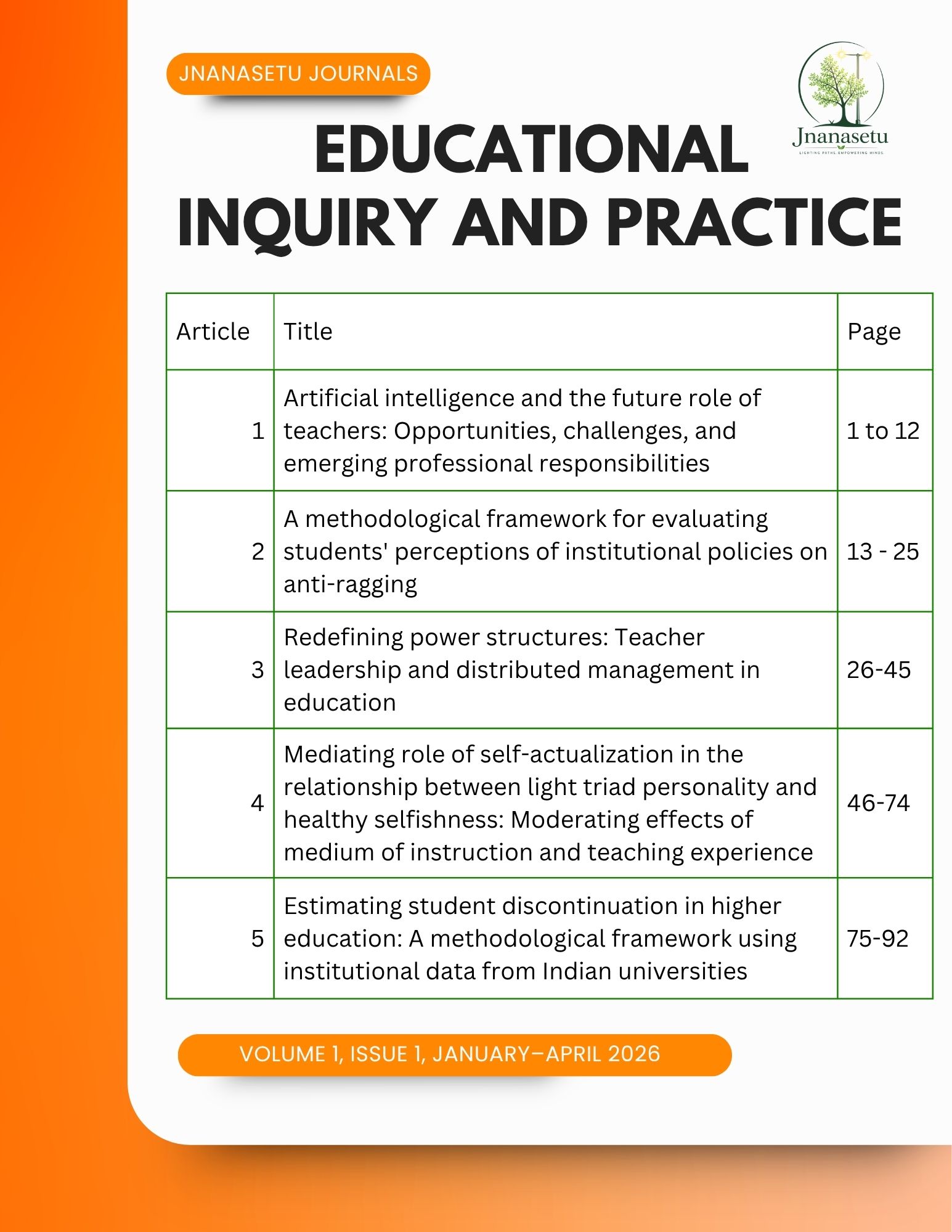
Artificial intelligence and the future role of teachers: Opportunities, challenges, and emerging professional responsibilities
DOI:
https://doi.org/10.66483/eip.2026.1.1.001Keywords:
Artificial Intelligence, Teacher Roles, Teacher Education, AI Literacy, Human–AI ComplementarityAbstract
Artificial intelligence (AI) is increasingly influencing educational practice through applications such as personalised learning, automated assessment, learning analytics, and generative AI tools. These developments have generated debate regarding the future role of teachers and the extent to which AI may transform educational work. Drawing on the perspective of human–AI complementarity, this conceptual article examines how AI is reshaping teaching by creating new opportunities, introducing significant challenges, and expanding teachers' professional responsibilities. The discussion highlights the potential of AI to support personalised instruction, timely feedback, data-informed decision-making, and professional learning. At the same time, concerns about academic integrity, algorithmic bias, data privacy, and digital inequality continue to pose significant educational and ethical challenges. The article argues that AI is unlikely to replace teachers because effective teaching depends on human capacities such as pedagogical judgment, ethical reasoning, creativity, and socio-emotional support. Consequently, teachers are increasingly expected to facilitate learning, critically evaluate AI-generated information, provide ethical guidance, and promote AI literacy. The article concludes that the future of education depends on productive collaboration between teachers and AI rather than technological substitution.
References
Holmes, W., Bialik, M., & Fadel, C. (2019). Artificial intelligence in education: Promises and implications for teaching and learning. Center for Curriculum Redesign.
Ifenthaler, D., & Yau, J. Y. K. (2020). Utilising learning analytics to support study success in higher education: A systematic review. Educational Technology Research and Development, 68(4), 1961–1990. https://doi.org/10.1007/s11423-020-09788-z
Kasneci, E., Sessler, K., Küchemann, S., Bannert, M., Dementieva, D., Fischer, F., Gasser, U., Groh, G., Günnemann, S., Hüllermeier, E., Krusche, S., Kutyniok, G., Michaeli, T., Nerdel, C., Pfeiffer, F., Poquet, O., Sailer, M., Schmidt, A., Seidel, T., ... Kasneci, G. (2023). ChatGPT for good? On opportunities and challenges of large language models for education. Learning and Individual Differences, 103, 102274. https://doi.org/10.1016/j.lindif.2023.102274
Koehler, M. J., Mishra, P., & Cain, W. (2013). What is technological pedagogical content knowledge (TPACK)? Journal of Education, 193(3), 13–19. https://doi.org/10.1177/002205741319300303
Long, D., & Magerko, B. (2020). What is AI literacy? Competencies and design considerations. Proceedings of the 2020 CHI Conference on Human Factors in Computing Systems, 1–16. https://doi.org/10.1145/3313831.3376727
Long, D., & Magerko, B. (2020). What is AI literacy? Competencies and design considerations. Proceedings of the 2020 CHI Conference on Human Factors in Computing Systems, 1–16. https://doi.org/10.1145/3313831.3376727
Luckin, R. (2018). Machine learning and human intelligence: The future of education for the 21st century. UCL Institute of Education Press.
Ma, W., Adesope, O. O., Nesbit, J. C., & Liu, Q. (2014). Intelligent tutoring systems and learning outcomes: A meta-analysis. Journal of Educational Psychology, 106(4), 901–918. https://doi.org/10.1037/a0037123
Selwyn, N. (2019). Should robots replace teachers? AI and the future of education. Polity Press.
Tlili, A., Shehata, B., Adarkwah, M. A., Bozkurt, A., Hickey, D. T., Huang, R., & Agyemang, B. (2023). What if the devil is my guardian angel: ChatGPT as a case study of using chatbots in education. Smart Learning Environments, 10(1), 15. https://doi.org/10.1186/s40561-023-00237-x
Trust, T., Krutka, D. G., & Carpenter, J. P. (2016). “Together we are better”: Professional learning networks for teachers. Computers & Education, 102, 15–34. https://doi.org/10.1016/j.compedu.2016.06.007
UNESCO. (2021). Recommendation on the ethics of artificial intelligence. UNESCO.
UNESCO. (2023). Guidance for generative AI in education and research. UNESCO.
Williamson, B., & Eynon, R. (2020). Historical threads, missing links, and future directions in AI in education. Learning, Media and Technology, 45(3), 223–235. https://doi.org/10.1080/17439884.2020.1798995
Zawacki-Richter, O., Marín, V. I., Bond, M., & Gouverneur, F. (2019). Systematic review of research on artificial intelligence applications in higher education—Where are the educators? International Journal of Educational Technology in Higher Education, 16(39). https://doi.org/10.1186/s41239-019-0171-0
Downloads
Published
Versions
- 2026-08-11 (2)
- 2026-06-15 (1)
Data Availability Statement
No primary data is used
Issue
Section
License
Copyright (c) 2026 Ashwini Baja, Ribha Singh (Author)

This work is licensed under a Creative Commons Attribution-NonCommercial 4.0 International License.