
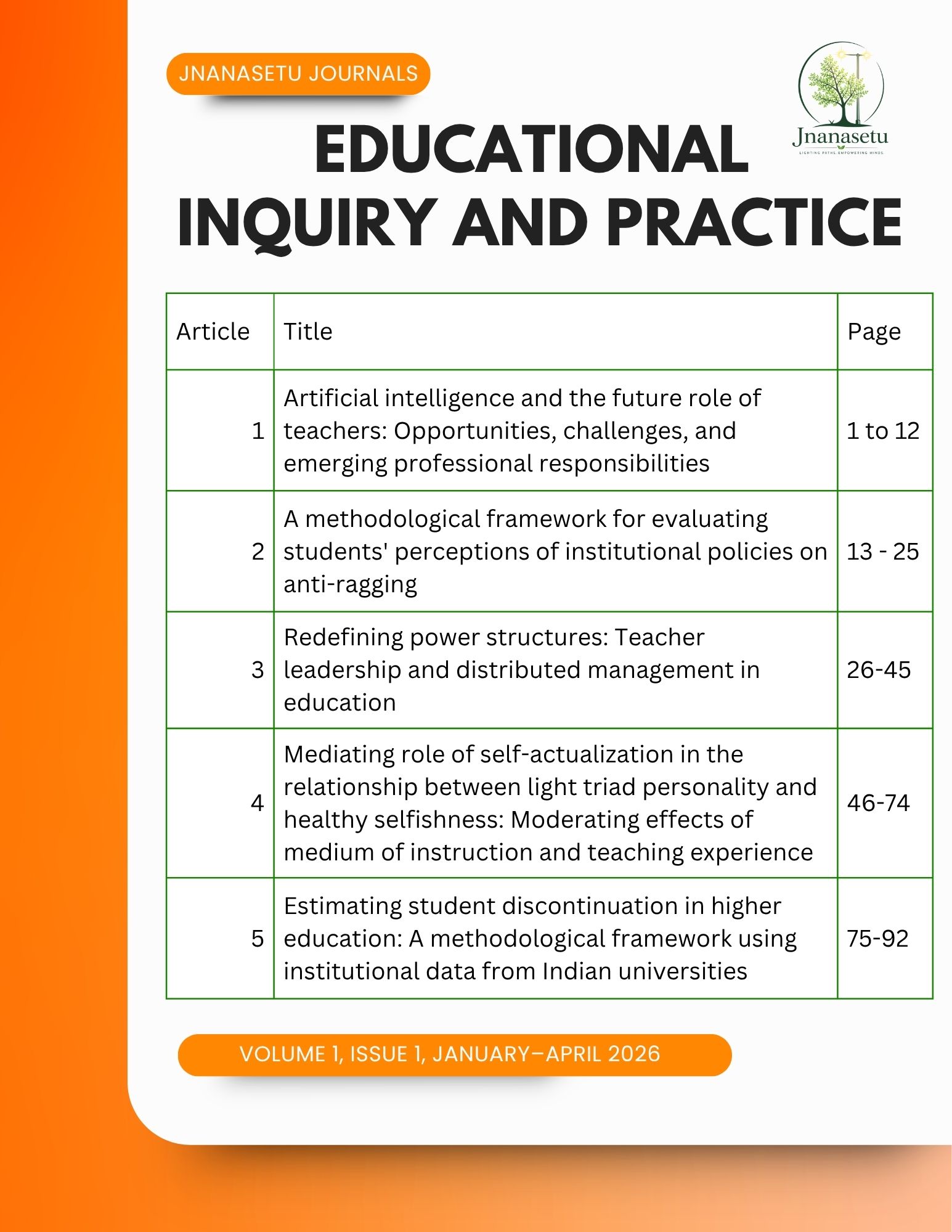
Mediating role of self-actualization in the relationship between light triad personality and healthy selfishness: Moderating effects of medium of instruction and teaching experience
DOI:
https://doi.org/10.66483/eip.2026.1.1.004Keywords:
Healthy Selfishness, Light Triad Personality, Self-actualizationAbstract
Purpose: This paper analyzes the mediating effect of self-actualization on the relationship between light triad personality and healthy selfishness. It also examines whether the medium of instruction and teaching experience strengthen or weaken the relationship between the predictor variable (light triad personality) and the mediating variable (self-actualization).
Method: The Self-actualization Scale (Kaufman, 2018), the Light Triad Scale (Kaufman et al., 2019), and the Healthy Selfishness Scale (Kaufman & Jauk, 2020), with modifications for the research context, were administered to teacher trainees.
Findings: The analysis revealed a significant impact of light triad personality, medium of instruction, and teaching experience on self-actualization. Both light triad personality and self-actualization significantly influence healthy selfishness. Furthermore, self-actualization substantially mediates the relationship between light triad personality and healthy selfishness. Additionally, the medium of instruction also significantly moderates the relationship between light triad personality and self-actualization, highlighting its crucial role.
Practical Implications: The findings suggest that educators should help teacher trainees understand their personality type and how it influences self-actualization and healthy behaviors. Additionally, lessons should incorporate multilingual aspects to enhance teaching-learning experiences and support teacher trainees’ self-actualization.
References
Abikari, M., Öhman, P., & Yazdanfar, D. (2022). Negative emotions and consumer behavioural intention to adopt emerging e-banking technology. Journal of Financial Services Marketing, 28(4), 691–704. https://doi.org/10.1057/s41264-022-00172-x
Adam-Bagley, C., Abubaker, M., & Sawyerr, A. (2023). Retelling Our Stories through Social Science: Abraham Maslow, Religion and Human Transcendence. Open Journal of Social Sciences, 11(8), 36–60. https://doi.org/10.4236/jss.2023.118003
Alqarni, N. A. (2021). Well-being and the Perception of Stress among EFL University Teachers in Saudi Arabia. Journal of Language and Education, 7(3), 8–22. https://doi.org/10.17323/jle.2021.11494
Bălan, A. S., Ionescu, M. C., & Stan, A. (2023). Light triad personality traits and coping strategies in teachers. Current Trends in Natural Sciences, 12(23), 150-159. https://doi.org/10.47068/ctns.2023.v12i23.016
Bagozzi, R. P., Yi, Y., & Phillips, L. W. (1991). Assessing Construct Validity in Organizational Research. Administrative Science Quarterly, 36(3), 421–421. https://doi.org/10.2307/2393203
Boroditsky, L. (2011). How Language Shapes Thought. Scientific American, 304(2), 62–65. http://www.jstor.org/stable/26002395
Boyle, G. J. (1991). Does item homogeneity indicate internal consistency or item redundancy in psychometric scales? Personality and individual differences, 12(3), 291-294.
Brittain, L. (2025). The importance of self-care to avoid teacher burnout (Master's capstone project, Northwestern College). NWCommons. https://nwcommons.nwciowa.edu/education_masters/774/
Bardach, L., Klassen, R. M., & Perry, N. E. (2022). Teachers’ psychological characteristics: Do they matter for teacher effectiveness, teachers’ well-being, retention, and interpersonal relations? An integrative review. Educational psychology review, 34(1), 259-300. https://doi.org/10.1007/s10648-021-09614-9
Chua, S. L., & Welch, G. F. (2021). A lifelong perspective for growing music teacher identity. Research Studies in Music Education, 43(3), 329-346. https://doi.org/10.1177/1321103X19875080
Chang, H. H., & Chen, S. W. (2008). The impact of online store environment cues on purchase intention: trust and perceived risk as a mediator. Online Information Review, vol. 32, no. 6, pp. 818-41.
Cho, E., & Kim, S. (2014). Cronbach’s coefficient alpha: Well known but poorly understood. Organizational research methods, 18(2), 207-230.
Clarke-Woolley, C. (1976). The Relationship of an Instrumented T-group and Personality Changes in Self-concept and Self-actualization: A Thesis presented in partial fulfilment of the requirements for the degree of Master of Arts in Psychology at Massey University. [Doctoral dissertation, Massey University]. http://hdl.handle.net/10179/13507
Cronbach, L. J. (1951). Coefficient Alpha and the Internal Structure of Tests. Psychometrika, 16(3), 297–334. https://doi.org/10.1007/bf02310555
Cortina, J. M. (1993). What is coefficient alpha? An examination of theory and applications. Journal of Applied Psychology, 78(1), 98.
Chen, A. P., Nigri, G., Culham, T. E., Nussbaum, B., Peregoy, R., & Plunkett, M. (2024). The Manager and Love: Evoking a Loving Inquiry in a Group Setting. Humanistic Management Journal, 9(2), 183-202. https://doi.org/10.1007/s41463-024-00178-8
Carlson, R. W., Adkins, C., Crockett, M. J., & Clark, M. S. (2022). Psychological selfishness. Perspectives on Psychological Science, 17(5), 1359-1380. https://doi.org/10.1177/17456916211045692
Dahl, R. J., Wakefield, J. A., Kimlicka, T. M., Wiederstein, M., & Cross, H. J. (1983). How the Personality Dimensions of Neuroticism, Extraversion and Psychoticism Relate to Self-actualization. Personality and Individual Differences, 4(6), 683–685. https://doi.org/10.1016/0191-8869(83)90123-x
Dewaele, J. M. (2015). On emotions in foreign language learning and use. The language teacher, 39(3), 13-15.
Falk, R. F., & Miller, N. B. (1992). A Primer for Soft Modeling. https://psycnet.apa.org/record/1992-98610-000
Fornell, C., & Larcker, D. F. (1981). Evaluating Structural Equation Models with Unobservable Variables and Measurement Error. Journal of Marketing Research, 18(1), 39–39. https://doi.org/10.2307/3151312
Gerymski, R., & Krok, D. (2019). Psychometric Properties and Validation of the Polish Adaptation of the Light Triad Scale. Current Issues in Personality Psychology, 7(4), 341-354.
Guttman, L. (1945). A basis for analyzing test-retest reliability. Psychometrika, 10(4), 255-282. https://doi.org/10.1007/BF02288892
Green, S. B., Lissitz, R. W., & Mulaik, S. A. (1977). Limitations of coefficient alpha as an index of test unidimensionality1. Educational and Psychological Measurement, 37(4), 827-838. https://doi.org/10.1177/001316447703700403
Hair Jr., J. F., Hult, G. T. M., Ringle, C., & Sarstedt, M. (2016). A Primer on Partial Least Squares Structural Equation Modeling (PLS-SEM). Thousand Oaks, CA: Sage Publications.
Hair, J. F., Hult, G. T. M., Ringle, C. M., & Sarstedt, M. (2014). A primer on partial least squares structural equation modeling (PLS-SEM). In DigitalCommons - Kennesaw State University (Kennesaw State University). Kennesaw State University. https://digitalcommons.kennesaw.edu/facbooks2014/39
Hair, J. F., Hult, G. T. M., Ringle, C. M., Sarstedt, M., Danks, N. P., & Ray, S. (2021). Partial Least Squares Structural Equation Modeling (PLS-SEM) Using R. In Classroom companion: business. Springer International Publishing. https://doi.org/10.1007/978-3-030-80519-7
Hair, J. F., Ringle, C. M., & Sarstedt, M. (2011). PLS-SEM: Indeed a Silver Bullet. The Journal of Marketing Theory and Practice, 19(2), 139–152. https://doi.org/10.2753/mtp1069-6679190202
Heng, Q., & Chu, L. (2023). Self-efficacy, reflection, and resilience as predictors of work engagement among English teachers. Frontiers in Psychology, 14. https://doi.org/10.3389/fpsyg.2023.1160681
Hu, L., & Bentler, P. M. (1999). Cutoff criteria for fit indexes in covariance structure analysis: Conventional criteria versus new alternatives. Structural Equation Modeling A Multidisciplinary Journal, 6(1), 1–55. https://doi.org/10.1080/10705519909540118
Humphreys, L. G. (1956). The normal curve and the attenuation paradox in test theory. Psychological Bulletin, 53(6), 472–476. https://doi.org/10.1037/h0041091
Hogan, J. P., & White, P. (2021). A self-study exploration of early career teacher burnout and the adaptive strategies of experienced teachers. Australian Journal of Teacher Education (Online), 46(5), 18–39. https://search.informit.org/doi/10.3316/informit.051011407741269
Jacob, C. (1990). Statistical power analysis for the behavioral sciences. Computers Environment and Urban Systems, 14(1), 71–71. https://doi.org/10.1016/0198-9715(90)90050-4
Jayawickreme, E., & Blackie, L. E. (2014). Post–traumatic growth as positive personality change: Evidence, controversies and future directions. European Journal of Personality, 28(4), 312-331. https://doi.org/10.1002/per.1963
Kaplan, H. (2022). The unique effects of supporting beginning teachers’ psychological needs through learning communities and a teacher-mentor’s support: A longitudinal study based on self-determination theory. Frontiers in Psychology, 13. https://doi.org/10.3389/fpsyg.2022.859364
Kaplan, H., & Madjar, N. (2017). The Motivational Outcomes of Psychological Need Support among Pre-Service Teachers: Multicultural and Self-determination Theory Perspectives. Frontiers in Education, 2. https://doi.org/10.3389/feduc.2017.00042
Kaufman, S. B. (2018). Self-actualizing people in the 21st century: Integration with contemporary theory and research on personality and well-being. Journal of Humanistic psychology, 63(1), 51-83.
Kaufman, S. B., Yaden, D. B., Hyde, E., & Tsukayama, E. (2019). The Light vs. Dark Triad of Personality: Contrasting Two Very Different Profiles of Human Nature. Frontiers in Psychology, 10, 438704. https://doi.org/10.3389/fpsyg.2019.00467
Kaufman, S. B., & Jauk, E. (2020). Healthy selfishness and pathological altruism: Measuring two paradoxical forms of selfishness. Frontiers in psychology, 11, 1006. https://doi.org/10.3389/fpsyg.2020.01006
Kline, P. (1986). A handbook of test construction: Introduction to psychometric design. London: Methuen.
Kline, R. B. (2011). Principles and practice of structural equation modeling, 3rd ed. https://psycnet.apa.org/record/2010-18801-000
Kopalle, P. K., & Lehmann, D. R. (1997). Alpha Inflation? The Impact of Eliminating Scale Items on Cronbach’s Alpha. Organizational Behavior and Human Decision Processes, 70(3), 189–197. https://doi.org/10.1006/obhd.1997.2702
Kono, S., & Walker, G. (2020). Theorizing the interpersonal aspect of ikigai (‘life worth living’) among Japanese university students: A mixed-methods approach. International Journal of Wellbeing, 10(2). https://doi.org/10.5502/ijw.v10i2.979
Lewis, K. J., Walton, C. C., Slemp, G. R., & Osborne, M. S. (2022). Mindfulness and Nonattachment-To-Self in Athletes: Can Letting Go Build Well-being and Self-actualization? Mindfulness, 13(11), 2738–2750. https://doi.org/10.1007/s12671-022-01990-9
Loevinger, J. (1954). The attenuation paradox in test theory. Psychological Bulletin, 51(5), 493–504. https://doi.org/10.1037/h0058543
Lukić, P., & Živanović, M. (2021). Shedding light on the Light Triad: Further evidence on structural, construct, and predictive validity of the Light Triad. Personality and Individual Differences, 178, 110876–110876. https://doi.org/10.1016/j.paid.2021.110876
Lucke, J. F. (2005). “Rassling the hog”: The influence of correlated item error on internal consistency, classical reliability, and congeneric reliability. Applied psychological measurement, 29(2), 106-125.
Maslow, A. H. (1943). A theory of human motivation. Psychological Review, 50(4), 370–396. https://doi.org/10.1037/h0054346
Maslow, A. H. (1987). Motivation and personality, 3rd ed. https://psycnet.apa.org/record/1987-98126-000
McDonald, R. P. (1981). The dimensionality of tests and items. British Journal of mathematical and statistical Psychology, 34(1), 100-117.
Nunnally, J. C., & Bernstein, I. H. (1994). Psychometric theory (3rd ed.). New York: McGraw-Hill.
Nunnally, J. C. (1967). Assessment of reliability. Psychometric theory, 206-235. McGraw-Hill Education
Nigat-Tulod, R. J. (2025). Challenges faced by Non-Native English-Speaking Teachers (NNESTs) in selected foreign classrooms in Macau. Pantao, International Journal of the Humanities and Social Sciences, 4(2), 140-147. https://doi.org/10.69651/pijhss040216
Orosova, O., Nováková, J., & Gajdosova, B. (2026). Dark and Light Triad Traits, Age, and Female Teacher well-being – A Parallel Mediation Analysis. European Journal of Mental Health, 21, 1–15. https://doi.org/10.5708/ejmh.21.2026.0049
O’Connor, D., & Yballe, L. (2007). Maslow revisited: Constructing a road map of human nature. Journal of Management Education, 31(6), 738-756. https://doi.org/10.1177/1052562907307639
Pett, M.A., Lackey, N.R. and Sullivan, J.J. (2003) Making Sense of Factor Analysis: The Use of Factor Analysis for Instrument Development in Health Care Research. SAGE Publications, Thousand Oaks. http://dx.doi.org/10.4135/9781412984898
Peterson, R. A. (1994). A meta-analysis of Cronbach’s coefficient alpha. Journal of Consumer Research, 21(2), 381-391.
Pearson, L. C., & Moomaw, W. (2005). The relationship between teacher autonomy and stress, work satisfaction, empowerment, and professionalism. Educational research quarterly, 29(1), 38-54.
Răducu, C. M., & Stănculescu, E. (2022). Personality and socio-demographic variables in teacher burnout during the COVID-19 pandemic: a latent profile analysis. Scientific reports, 12(1), 14272. https://doi.org/10.1038/s41598-022-18581-2
Robbins, B. D. (2021). The joyful life: An existential-humanistic approach to positive psychology in the time of a pandemic. Frontiers in Psychology, 12, 648600. https://doi.org/10.3389/fpsyg.2021.648600
Rahmawati, E. N., & Tusyanah, T. (2025). The Influence of Digital Literacy, Teaching Experiences, Teaching Professional Perception, and Self-Efficacy as Mediating on Professional Competence as Prospective Teacher. Jurnal Pendidikan Administrasi Perkantoran (JPAP), 13(2), 514-527. https://doi.org/10.26740/jpap.v13n2.p514-527
Suyatno, S., Pambudi, D. I., Wantini, W., Abdurrohim, A., & Mardati, A. (2022, September). The mediating role of meaning at work in promoting teacher commitment and reducing burnout. In Frontiers in Education (Vol. 7, p. 962163). Frontiers Media SA. https://doi.org/10.3389/feduc.2022.962163
Sijtsma, K., & Pfadt, J. M. (2021). Part II: On the Use, the Misuse, and the Very Limited Usefulness of Cronbach’s Alpha: Discussing Lower Bounds and Correlated Errors. Psychometrika, 86(4), 843–860. https://doi.org/10.1007/s11336-021-09789-8
Souza, A. C. de, Alexandre, N. M. C., & Guirardello, E. de B. (2018). Psychometric properties in instruments evaluation of reliability and validity. PubMed, 26(3), 649–659. https://doi.org/10.5123/s1679-49742017000300022
Stavraki, M., Artacho-Mata, E., Bajo, M., & Díaz, D. (2022). The dark and light of human nature: Spanish adaptation of the light triad scale and its relationship with psychological well-being. Current Psychology, 42(31), 26979–26988. https://doi.org/10.1007/s12144-022-03732-5
Straub, D. W., & Gefen, D. (2004). Validation Guidelines for IS Positivist Research. Communications of the Association for Information Systems, 13. https://doi.org/10.17705/1cais.01324
Shao, G. (2023). A model of teacher enthusiasm, teacher self-efficacy, grit, and teacher well-being among English as a foreign language teachers. Frontiers in Psychology, 14, 1169824. https://doi.org/10.3389/fpsyg.2023.1169824
Soysal, F. S. Ö., & Bakalım, O. (2023). The healthy selfishness and pathological altruism scale: adaptation into Turkish and validity and reliability study. Anadolu University Journal of Education Faculty, 7(1), 160-174. https://doi.org/10.34056/aujef.1196150
Tian, X. (2025). A Study on Teacher Professional Growth and Teaching Improvement Strategies Based on Reflective Practice. International Journal of Education and Social Development, 4(3), 40-43. https://doi.org/10.54097/t7zxmw47
Taber, K. S. (2017). The Use of Cronbach’s Alpha When Developing and Reporting Research Instruments in Science Education. Research in Science Education, 48(6), 1273–1296. https://doi.org/10.1007/s11165-016-9602-2
Teo, T. S. H., Srivastava, S. C., & Jiang, L. (2008). Trust and Electronic Government Success: An Empirical Study. Journal of Management Information Systems, 25(3), 99–132. https://doi.org/10.2753/mis0742-1222250303
Troncoso, N. C. (1982). Exploratory Study of a Measure of Self-Actualization. University of North Florida Digital Commons (University of North Florida). https://digitalcommons.unf.edu/etd/696
Veeran, V. P. K., Veeran, M. P. K., Velayudhan, T., Suppiah, S. T., & Mathivanan. (2025). A Comparative Study on Self-Actualisation Levels Among Primary School Teachers. Social Science and Human Research Bulletin., 2(8). https://doi.org/10.55677/sshrb/2025-3050-0805
Ulfah, S. M., Rusmana, N., & Kembara, M. D. (2025). Teacher Self-Actualization and Professionalism in the 21st Century Education Era. Buana Pendidikan Jurnal Fakultas Keguruan Dan Ilmu Pendidikan, 21(2), 79–94. https://doi.org/10.36456/bp.vol21.no2.a10011
Vygotsky, L. S., & Cole, M. (1978). Mind in society: Development of higher psychological processes. Harvard university press.
Wang, Y. D., & Emurian, H. H. (2005). Trust in e-commerce: consideration of interface design factors. Journal of Electronic Commerce in Organizations, vol. 3, no. 4, pp. 42-60.
Wang, K., Yuan, R., & Costa, P. I. D. (2025). A critical review of English medium instruction (EMI) teacher development in higher education: From 2018 to 2022. Language Teaching, 58(2), 141–172. https://doi.org/10.1017/s0261444824000351
Wills, B. S. (1974). Personality Variables Which Discriminate Between Groups Differing in Level of Self-Actualization. Journal of Counseling Psychology, 21(3), 222–227. https://doi.org/10.1037/h0036467
Downloads
Published
Versions
- 2026-08-11 (2)
- 2026-06-15 (1)
Data Availability Statement
The raw data supporting the findings of this study are retained by the authors and may be made available upon reasonable request. However, the cleaned dataset and certain archived analytical output files used during data analysis are no longer available.
Issue
Section
License
Copyright (c) 2026 Dr. Hureen Wasifa Siddiqui, Dr. Majid Sadeeq (Author)

This work is licensed under a Creative Commons Attribution-NonCommercial 4.0 International License.