
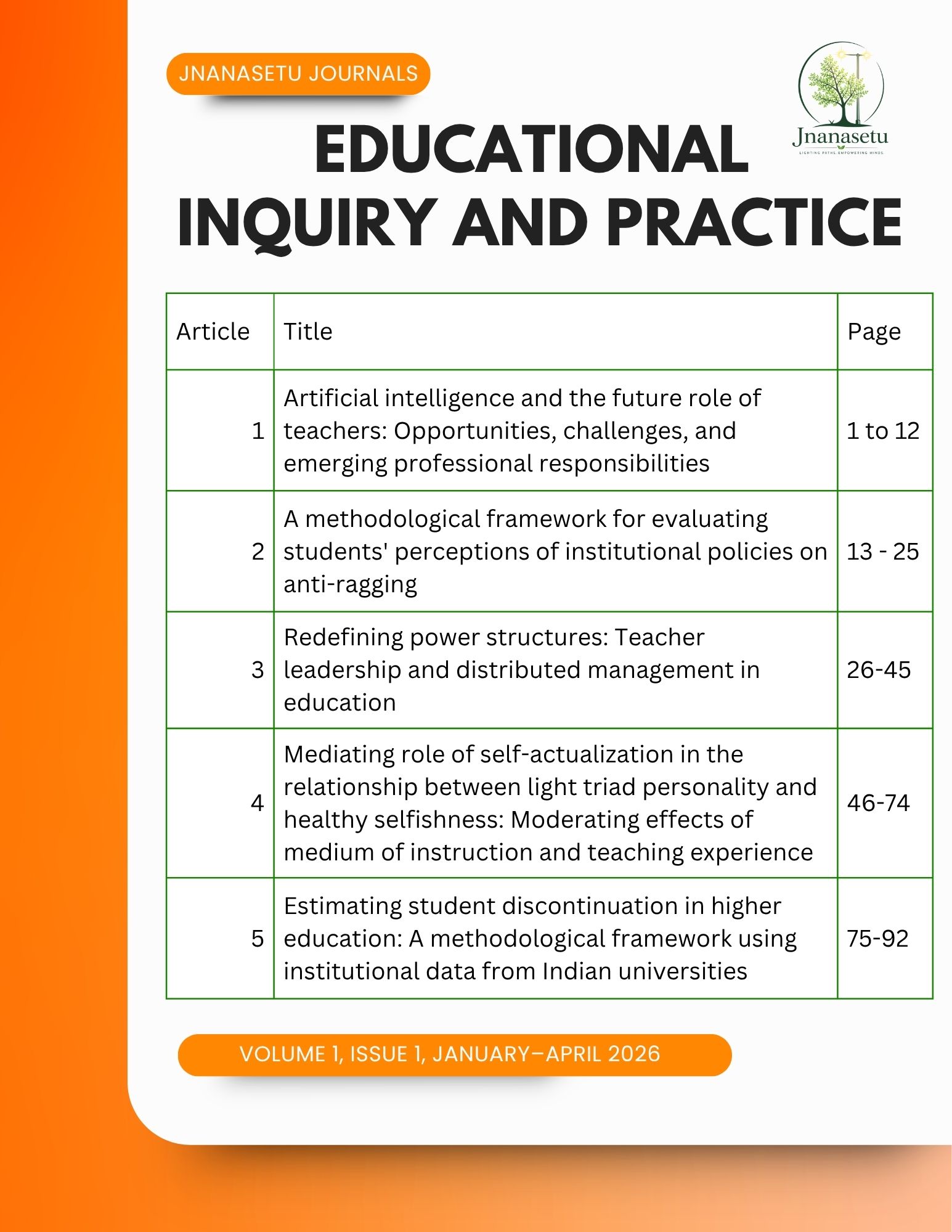
A Methodological framework for evaluating students' perceptions of institutional policies on anti-ragging
DOI:
https://doi.org/10.66483/eip.2026.1.1.002Keywords:
Higher education, Anti-ragging policy, Policy evaluation, Scale development, Student perceptionAbstract
Ragging remains a critical concern in higher education institutions in India, despite the implementation of regulatory measures such as anti-ragging policies. Existing studies have largely relied on descriptive approaches with limited theoretical grounding, thereby restricting the systematic evaluation of policy effectiveness. Addressing this gap, the present study proposes a multidimensional, theory-driven framework for assessing students’ perceptions of the implementation of institutional anti-ragging policies. The study integrates four key dimensions, awareness, institutional support, enforcement, and perceived safety, derived from established theoretical perspectives in social psychology, organizational behavior, and policy studies.
A descriptive research design was adopted, and data were collected from 80 students of Banaras Hindu University using a stratified random sampling technique. The researcher developed a 29-item instrument, the Anti-Ragging Policy Perception Scale (split-half reliability = 0.76), to measure students’ perceptions across the identified dimensions. The findings indicate that professional students reported relatively higher perception scores than non-professional students. However, chi-square analysis revealed no statistically significant association with course type or gender.
The results suggest that students’ perceptions of anti-ragging policies are generally consistent across demographic groups, reflecting a degree of uniformity in institutional implementation. The study highlights that effective policy perception depends not only on awareness but also on institutional support mechanisms, consistent enforcement, and a psychologically safe environment.
The study contributes to the literature by providing a standardized and theoretically grounded framework for evaluating institutional policies in higher education. Practically, this framework serves as a reliable diagnostic tool for higher education institutions to audit policy compliance, identify implementation gaps, and cultivate safer, more supportive campus environments.
References
Arepalli, S., Savanthe, A., Prasad, H., Chakravarthy, K., & Bhavani, P. (2017a). Ragging: Awareness and perception among undergraduate medical students: A cross-sectional study. International Journal of Medical Science and Public Health, 1. https://doi.org/10.5455/ijmsph.2017.1061721122016
Best, J.W., Kahn, J.V., Jha, A.K. (2017). Research in education (10th ed.). India, Pearson Education Services Pvt. Ltd.
Bhatnagar, A.B., & Bhatnagar, A. (2014). Measurement and evaluation. Meerut, R.Lall Book Depot.
Chakraborty, D. (2016a). Normative Research on Socio-Legal Impact of Ragging. Research Journal of Humanities and Social Sciences, 7(3), 181. https://doi.org/10.5958/2321-5828.2016.00029.2
Edmondson, A. (1999). Psychological safety and learning behavior in work teams. Administrative Science Quarterly, 44(2), 350–383. https://www.jstor.org/stable/2666999
Eisenberger, R., Huntington, R., Huchison, S., & Sowa, D. (1986). Perceived Organizational Support. Journal of Applied Psychology, 71(3), 500–507. https://doi.org/10.1037/0021-9010.71.3.500
Fishbein, M., & Ajzen, I. (1975). Belief, attitude, intention, and behavior: An introduction to theory and research. Addison-Wesley. https://people.umass.edu/aizen/f&a1975.html
Garrett, H. E. (2008). Statistics in psychology and education. Surjeet Publications.
Lekamwasam, S., Rodrigo, M., Wickramathilake, M., Wijesinghe, C., Wijerathne, G., Silva, A. D., Napagoda, M., Attanayake, A., & Perera, C. (2015). Preventing ragging: outcome of an integrated programme in a medical faculty in Sri Lanka. Indian Journal of Medical Ethics. https://doi.org/10.20529/ijme.2015.059
Likert, R. (1932). A technique for the measurement of attitudes. Archives of Psychology, 22 140, 55. https://ia601806.us.archive.org/17/items/likert-1932/Likert_1932.pdf
Mangal, S.K. (2017). Statistics in psychology and education (2nd ed.). Delhi, PHI Learning Pvt. Ltd.
Nallapu, S. S. R. (2013). Students perceptions and feedback on ragging in a South Indian medical college. South-East Asian Journal of Medical Education, 7(2), 33. https://doi.org/10.4038/seajme.v7i2.138
Pressman, J., & Wildavsky, A. (1973). Implementation: How Great Expectations in Washington Are Dashed in Oakland (1st ed.). University of California Press.
Raghavan, R. K. (Chairman). (2007). The menace of ragging in educational institutions and measures to curb it. https://files.iittp.ac.in/pdfs/Committee-Report.pdf.
Sabu, M., Joseph, A., Benny, J., Lalan, L., PS, M., & D’Silva, P. (2020). A Study to assess stress and stressors among Undergraduate nursing students in a selected college at Mangaluru. Indian Journal of Continuing Nursing Education, 8(10), 172-177. https://doi.org/10.4103/ijcn.ijcn_133_20
Shakya, D., & Maskey, R. (2012). “Ragging”: What the medical students of a health institute from Eastern Nepal say?. Sunsari Technical College Journal, 1(1), 27–32. https://doi.org/10.3126/stcj.v1i1.8658
Sletto, R. F., & Edwards, A. L. (1957). Techniques of Attitude Scale Construction. American Sociological Review, 22(6), 762. https://doi.org/10.2307/2089210
Sharma, L., & Khusboo. (2013). Attitude of college students of different non- professional courses towards ragging: analysis. Journal Of Educational Chronicle, 4(1), 15-20. https://www.ipsgwalior.org/chronicle/download.php?filename=V4I1/Laxmi%20Sharma%20and%20Khusboo.pdf
Suryawanshi, J.V., & Hazari, M. (2016). Awareness and perception about ragging amongst Medical Undergraduate Students: A Cross-Sectional Study. International Journal of Community Medicine and Public Health, 3(5), 1119-1122. http://dx.doi.org/10.18203/2394-6040.ijcmph 20161369
Downloads
Published
Versions
- 2026-08-11 (2)
- 2026-06-15 (1)
Issue
Section
License
Copyright (c) 2026 Laxmipriya Kanti, Dr. Yogendra Kumar Prajapati (Author)

This work is licensed under a Creative Commons Attribution-NonCommercial 4.0 International License.